Confidential · Deal Brief

The Lakehouse
Deal Brief.

Companion to the Lakehouse at Toyako JV proposal. Enter the access password to continue.

Incorrect password
HOTELA Cities KK · partnerships@hotelaniseko.com
Vol. 1 · No. 1
Prepared for Jonathan Hodgson
The Lakehouse Brief
A close legal & financial read of the Toyako JV
Saturday, May 17, 2026
Confidential · For Jonathan only
The Lead Story · Companion to JV Proposal

A two-part deal. Part 1 starts everything; Part 2 protects your ¥4,000,000,000.

Part 1 as previously proposed: Jonathan's ¥500,000,000 (USD $3,164,557) loan to HOTELA, backed by a HOTELA corporate bond, repaid principal + interest within 18 months — plus a 17.5% limited-partner interest in HOTELA Niseko Towers that delivers pro-rata profit at the flagship's full sell-through, uniformly with all other LPs. Part 2: a six-phase waterfall that pays Jonathan ¥4,000,000,000 (USD $25,316,456) before HOTELA earns its first yen of profit. Both parts close simultaneously and run in parallel from day one — masterplanning, surveys, drawings, permits, and marketing all begin immediately. Lakehouse sales open in 6–12 months from closing.

Your Floor
¥4,000,000,000
USD $25,316,456
Contractual minimum to Jonathan — paid in Phases 3 + 4 before HOTELA earns any profit.
Your Lakehouse Receipt
¥10,000,000,000
– ¥12,500,000,000
USD $63,291,139 – $79,113,924
Part 2 only — base case at ¥25B sales, high case at ¥30B. Part 1 LP distribution & interest are separate, additive.
Your Cash Outlay
¥0
USD $0
No equity call, no construction draw, no marketing top-up. You contribute the land only.
Lakehouse Sales Open
6 – 12 months
From closing day · parallel execution
Both parts close simultaneously. Masterplanning, surveys, permits, marketing all begin immediately. Tax rate target: ~10–15% capital gains.
From the Editor A companion to the main proposal

Jonathan — following our call, this is the companion document we discussed. The main proposal lays out the vision and the business case. This document is purpose-built for the close legal and financial read you'll want before saying yes.

This is essentially a two-part deal — please read both parts together; neither stands alone. Part 1 as previously proposed is your ¥500,000,000 (USD $3,164,557) loan to HOTELA at JV formation, backed by a HOTELA corporate bond, repaid principal + interest within 18 months from HOTELA Niseko Towers project reimbursements — together with a 17.5% limited-partner interest in HOTELA Niseko Towers that delivers a pro-rata profit distribution at the flagship's full sell-through, uniformly with all other LP holders. Part 2 is the Lakehouse JV itself: SPC GK formation, free-and-clear land contribution, the six-phase waterfall, and the ¥4,000,000,000 floor. Both parts close on the same day and run in parallel from there. Masterplanning, surveys, architectural drawings, land-development permits, and marketing build all begin immediately at closing — Lakehouse sales open in 6–12 months from closing. The two-part structure does not slow the project; it compresses time.

Three things this document does that the main proposal does not. First, it states both parts of the deal in plain bullets, no narrative. Second, it walks every yen of Lakehouse sales proceeds through the six-phase waterfall in the order you proposed on our call — your ¥4,000,000,000 (USD $25,316,456) is paid out as cost-of-land before HOTELA receives any profit distribution. Third, it stress-tests the protection of your ¥4,000,000,000 at every plausible revenue level, and lays out the tax-effectiveness structure point by point.

At the end, twenty-nine open items for you to push back on. Refining those answers is what takes this from a draft proposal to a binding term sheet. All figures throughout this brief show Japanese yen first, with the USD equivalent shown in parentheses at a reference rate of ¥158 = USD $1.00.

Kyle Burns HOTELA Cities KK · Hirafu, Niseko · Hokkaido
partnerships@hotelaniseko.com
Section 01 · How the Deal Begins

Two parts. One deal. Both close simultaneously.

This is not the Lakehouse JV by itself. Part 1 — your ¥500,000,000 loan to HOTELA, backed by a corporate bond, with a 17.5% LP interest — and Part 2 — the Lakehouse JV — close on the same day and run in parallel from day one. Read them as a single transaction in two simultaneous instruments. The two-part structure does not slow the project — it accelerates it: Lakehouse sales open in 6–12 months from closing.

Part 1 · Step 1 · The Trigger as previously proposed

¥500,000,000 loan + corporate bond + 17.5% LP stake in HOTELA Niseko Towers.

¥500,000,000
USD $3,164,557 · 18-month term · 17.5% LP interest in HOTELA Niseko Towers

At Lakehouse JV formation, you transfer ¥500,000,000 to HOTELA Corporation. HOTELA deploys the entire amount into sales and marketing for HOTELA Niseko Towers — the flagship whose sales velocity feeds the brand build that ultimately sells your Lakehouse units. You receive two instruments back: (i) a HOTELA corporate bond securing the principal, and (ii) a 17.5% limited-partner interest in HOTELA Niseko Towers.

Security on principal: the ¥500,000,000 is collateralized by a HOTELA corporate bond issued in your name at the moment of disbursement. Your downside is a contractual debt instrument with corporate-bond backing — not unsecured exposure.
  • Tranche I (debt): principal + interest within 18 months, repaid from HOTELA Niseko Towers project reimbursements; corporate bond extinguishes on repayment.
  • Tranche II (equity, 17.5% LP): limited-partner interest in HOTELA Niseko Towers delivering pro-rata profit distribution at the flagship's full sell-through — uniformly with all other LP holders.
  • Tranche II forecast: ¥840,000,000 – ¥945,000,000 (USD $5,316,456 – $5,981,013) pre-tax, based on HOTELA Niseko Towers profit pool of ¥4.8B – ¥5.4B. Total Part 1 return: ¥1,340,000,000 – ¥1,445,000,000 (USD $8.48M – $9.15M) ex Tranche I interest.
  • Ring-fenced from the Lakehouse SPC GK waterfall — zero impact on your ¥10–12.5 billion Lakehouse economics.
Detailed mechanics & LP distribution flow — Section 07
Part 2 · Triggered by Part 1 · The JV

The Lakehouse JV and the ¥4,000,000,000 floor.

¥4,000,000,000floor
USD $25,316,456 · contractually protected minimum

The SPC GK is incorporated 50/50. You contribute the 30,000 sqm Lake Tōya parcel free and clear; HOTELA funds the ¥1,000,000,000 (USD $6,329,114) interest-free seed loan into the GK. HOTELA finances 100% of development and 100% of marketing — roughly ¥7,000,000,000 (USD $44,303,797) in HOTELA exposure. You commit no further cash beyond Part 1.

  • Six-phase waterfall: Phases 1–2 recover HOTELA's cost; Phases 3–4 pay your ¥4,000,000,000 floor; Phase 5 is HOTELA's catch-up; Phase 6 splits the rest 50/50.
  • Expected receipt to Jonathan: ¥10,000,000,000 – ¥12,500,000,000 (USD $63,291,139 – $79,113,924) across base and high cases.
  • Capital-gains tax characterization on the entire receipt stream — approximately 10–15% rate, not 20%+ dividend rate.
  • 50% GK ownership surrendered at de minimis consideration once Phase 6 is fully discharged.
Detailed mechanics — Sections 03–06
Figure · Accelerated Execution Timeline

Despite a two-part legal structure, both parts run simultaneously from day one.

Part 1 and Part 2 close on the same day. From the moment of closing, masterplanning, surveys, architectural drawings, land-development permits, and marketing build all begin in parallel. There is no sequential "wait for Part 1 to repay before Part 2 begins" delay — every workstream runs at the same time, and the project compounds time.

Lakehouse sales open in 6–12 months from closing
Month 0 · closing day
Both parts close together
  • P1¥500,000,000 wired; corporate bond issued; 17.5% LP interest granted
  • P2SPC GK incorporated, 50/50; land contributed free and clear; ¥1,000,000,000 seed loan funded
  • P2Masterplanning kickoff immediately
Month 1 – 3
Site, design & brand work begin
  • P2Site surveys + environmental baseline
  • P2Architectural concept design
  • P1Niseko Towers campaign launches with the ¥500M S&M deployment
Month 3 – 6 · LDP gate
Permits, drawings & LDP approval
  • P2Land Development Permit (LDP) filed and approved
  • P2Detailed architectural drawings + engineering
  • P2Lakehouse 13-language marketing assets built
Month 6 – 12 · Sales Open
Nin'i Kumiai sales open on LDP approval
  • P2First Lakehouse closings begin — no Takken Gyō licence required
  • P2Six-phase waterfall Phase 1 cash flow begins
  • P1Niseko Towers velocity compounding from brand build
Month 12 – 18
Tranche I principal repaid
  • P1¥500,000,000 principal + interest returned from Niseko Towers reimbursements
  • P1Corporate bond extinguishes on repayment
  • P117.5% LP interest continues through to sell-through
Month 24 – 60
Sell-through & full distributions
  • P2Lakehouse construction completes; sell-through
  • P2Waterfall Phases 1–6 play out → your ¥4B floor + Phase 6 50/50
  • P1Niseko Towers sell-through → Tranche II pro-rata LP distribution on your 17.5%
Time compounding is part of the deal. Running Part 1 first and Part 2 second sequentially would push first Lakehouse sales out by 18+ months. Running both in parallel collapses the runway to first closing into a 6–12 month window from today — faster brand build, faster sales, faster waterfall, faster path to your ¥4B floor and to your Tranche II 17.5% LP distribution. Legend: P1 Part 1 workstream (Niseko Towers / your loan) · P2 Part 2 workstream (Lakehouse JV).
Why the product commands premium · the differentiation

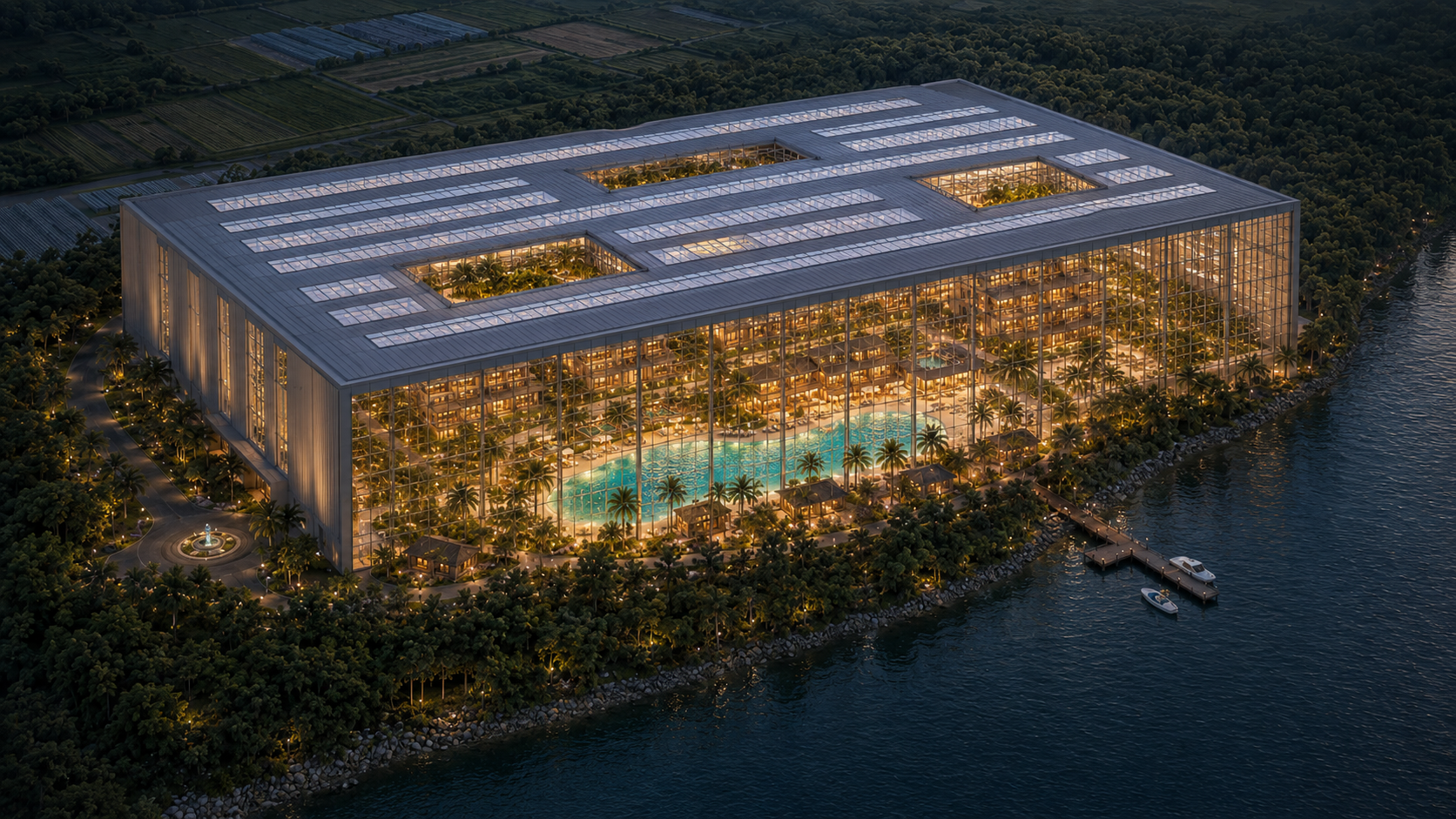
An enclosed, all-year indoor beach club — first-of-its-kind for branded residences.

The signature amenity is not an open lakeside beach. It is a fully enclosed, climate-controlled, all-year-round indoor beach environment with the entire branded-residence community housed inside the structure. Owners step from their residence into a sand-and-warm-water environment in February as easily as in August.

Indoor beach precedents exist as standalone attractions (Tropical Islands in Germany; the historical Seagaia Ocean Dome in Miyazaki). What is novel here is the integration: branded-residence ownership inside an enclosed all-year beach club — not hotel rooms, not short-stay rentals, but Nin'i Kumiai-owned residences.

  • Climate: Hokkaido latitude with a beach amenity functional 365 days a year
  • Engineering: Delivered through an established global lagoon / enclosed-environment specialist with whom HOTELA has an existing relationship
  • Pricing impact: A genuinely category-defining differentiator — supports the ¥357M–¥428M per-unit underwriting band against any Niseko comparable
  • Year-round occupancy: Owner usage is not seasonal — beach in winter is the headline
Note: "first-of-its-kind" framing avoids absolute "world's first" until HOTELA's competitive precedent search is final. Closest precedents are non-residential (water-park / hotel-room formats); branded-residence integration appears novel.
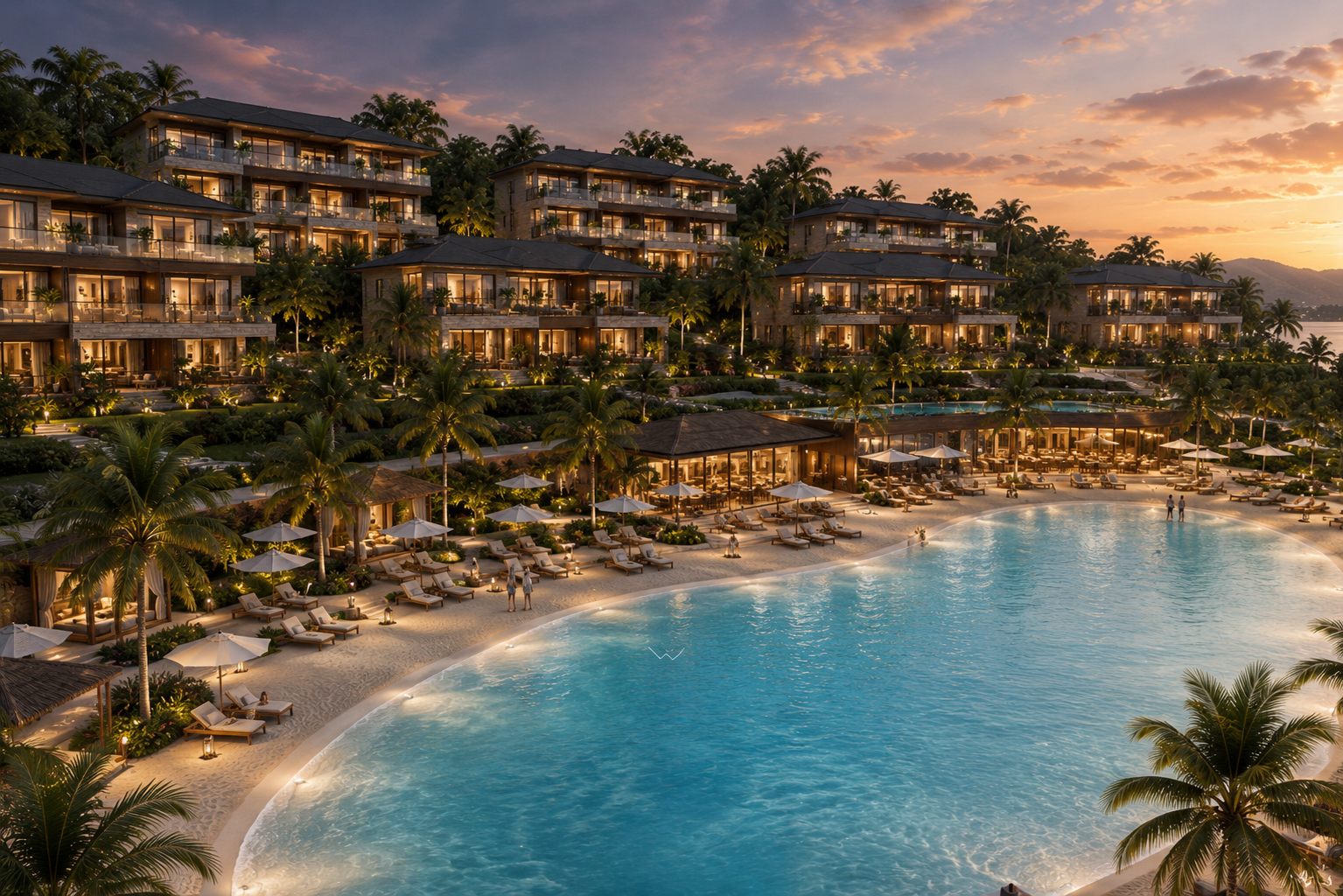
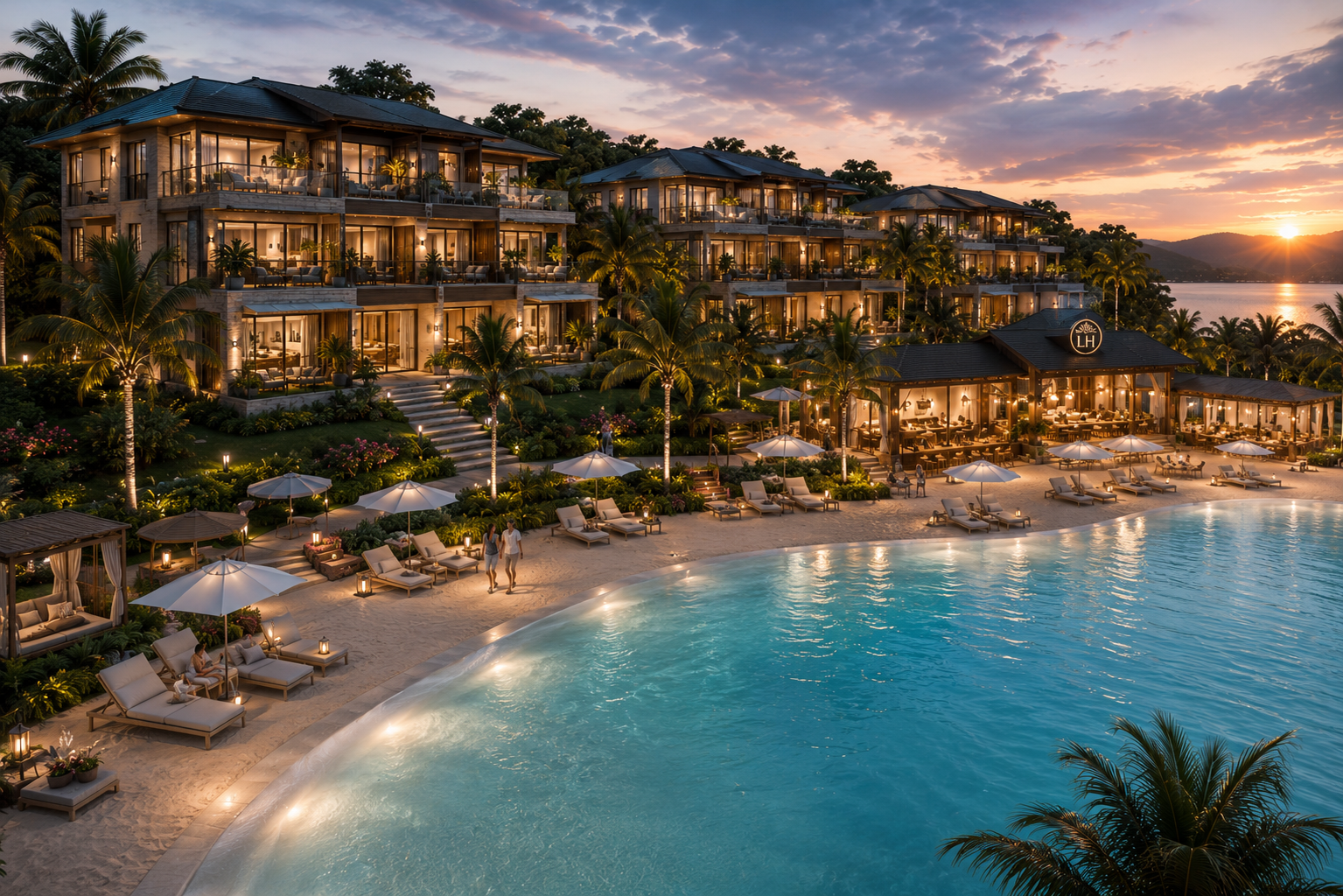
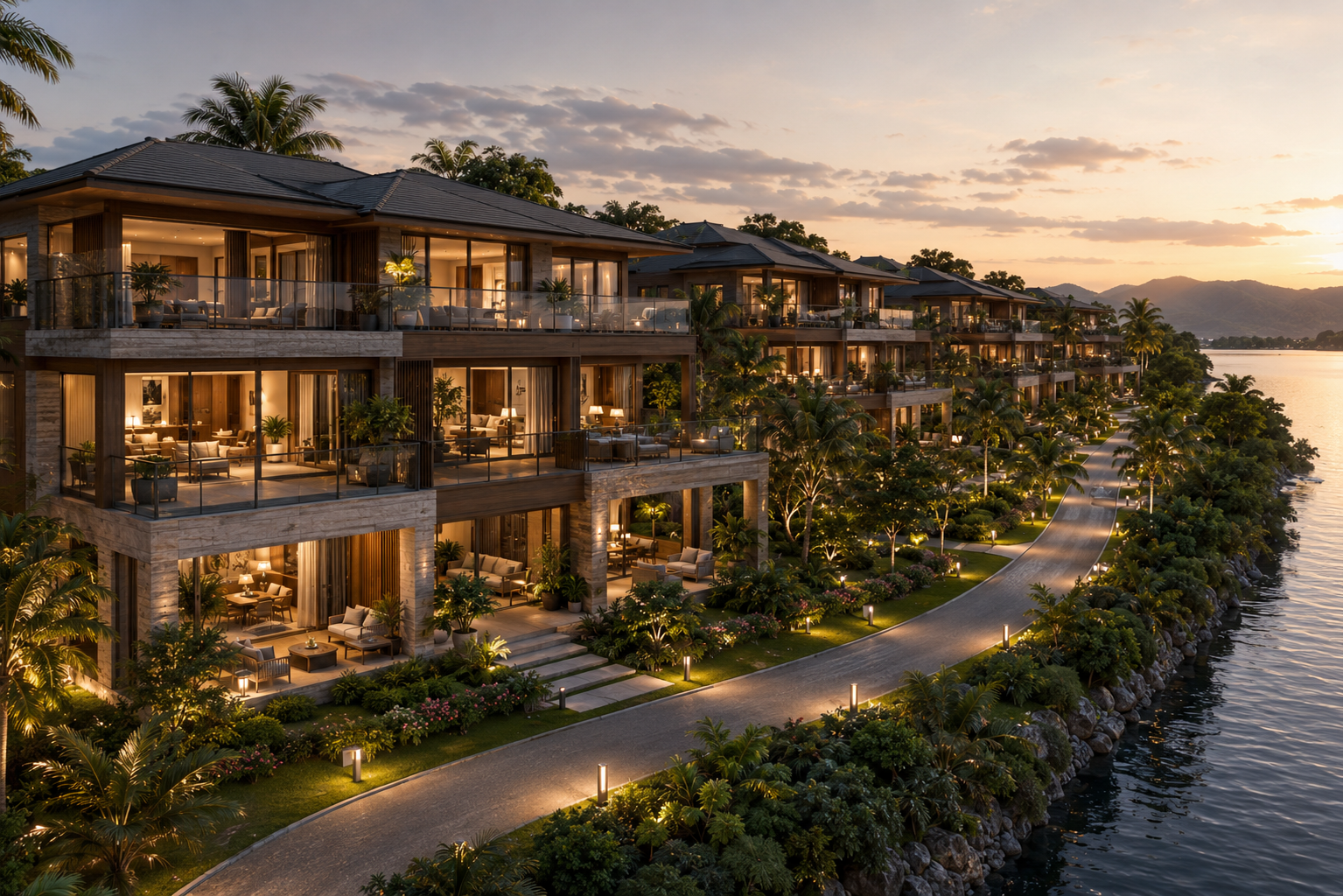
Design Vision · Early Concept Renderings

HOTELA Beach Club and Lakehouse at Toyako — two design directions in early concept review.

Early plates for HOTELA Beach Club and Lakehouse at Toyako from the design team. Two directions are under active concept review: (A) the open-air resort aesthetic — the traditional HOTELA architectural language carried forward into a Lake Tōya context (Plates 1–5); and (B) the enclosed all-year structure — the entire branded-residence community housed inside a single enclosed, climate-controlled volume (Plate 6, featured). Final architectural direction is set at design stage; both are shown here so you see the design optionality being underwritten.

Direction A · Open-Air Resort
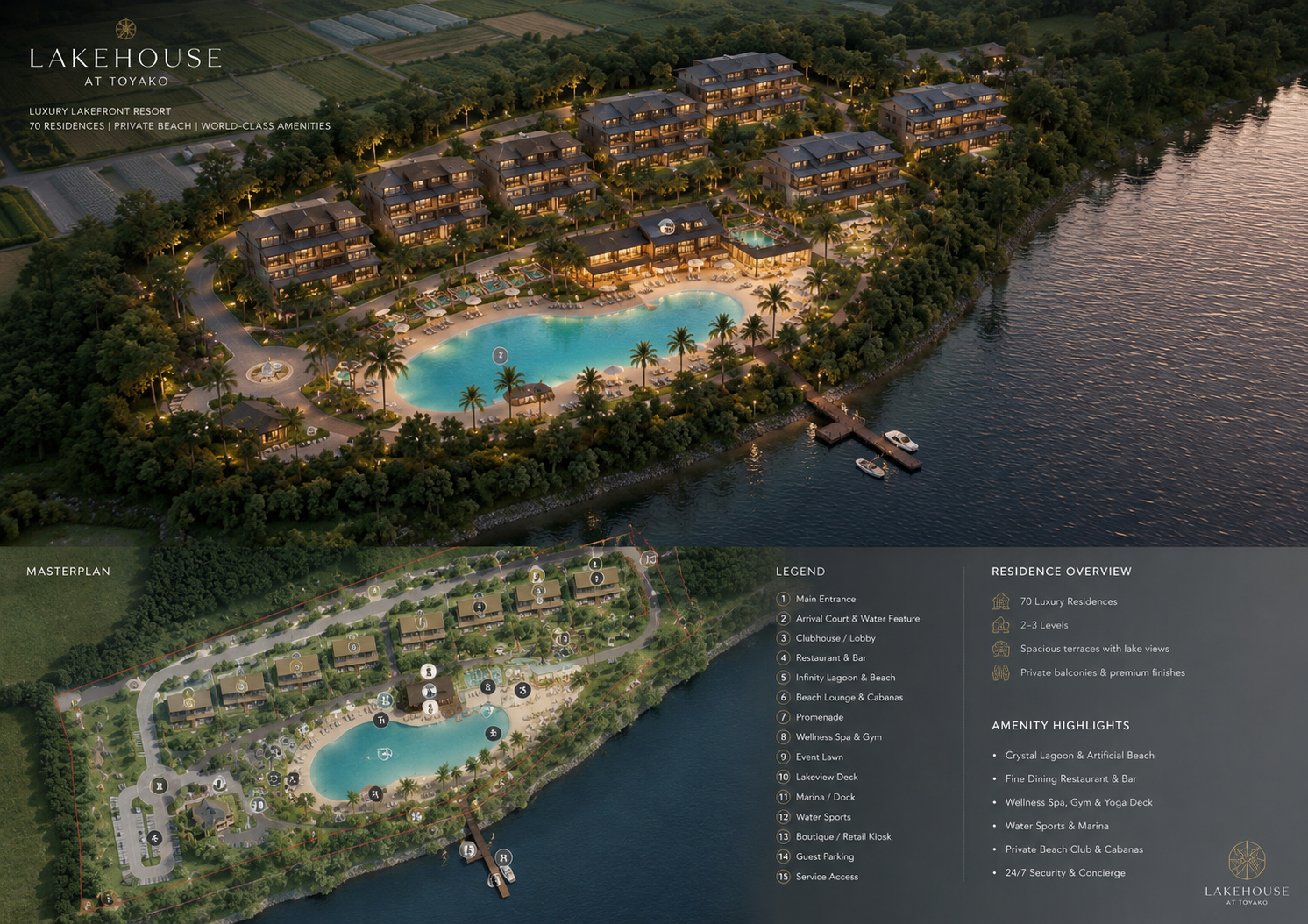
HOTELA Beach Club and Lakehouse at Toyako — masterplan, residences, & the artificial beach & lagoon.

Open-air architectural language — terraced residences stepping down to a crystal-water lagoon and sand beach, with a clubhouse, dining pavilion, spa, and marina dock. Premium Hokkaido-meets-coastal aesthetic, working with the lakefront edge.

HOTELA Beach Club and Lakehouse at Toyako masterplan with legend, residence overview, and amenity highlights
Plate 1HOTELA Beach Club and Lakehouse at Toyako — masterplan + legendFull site plan showing residence clusters around the artificial lagoon, marina dock, lakefront promenade, and amenity buildings. 70 luxury residences, 2–3 levels, with private beach & world-class amenities.
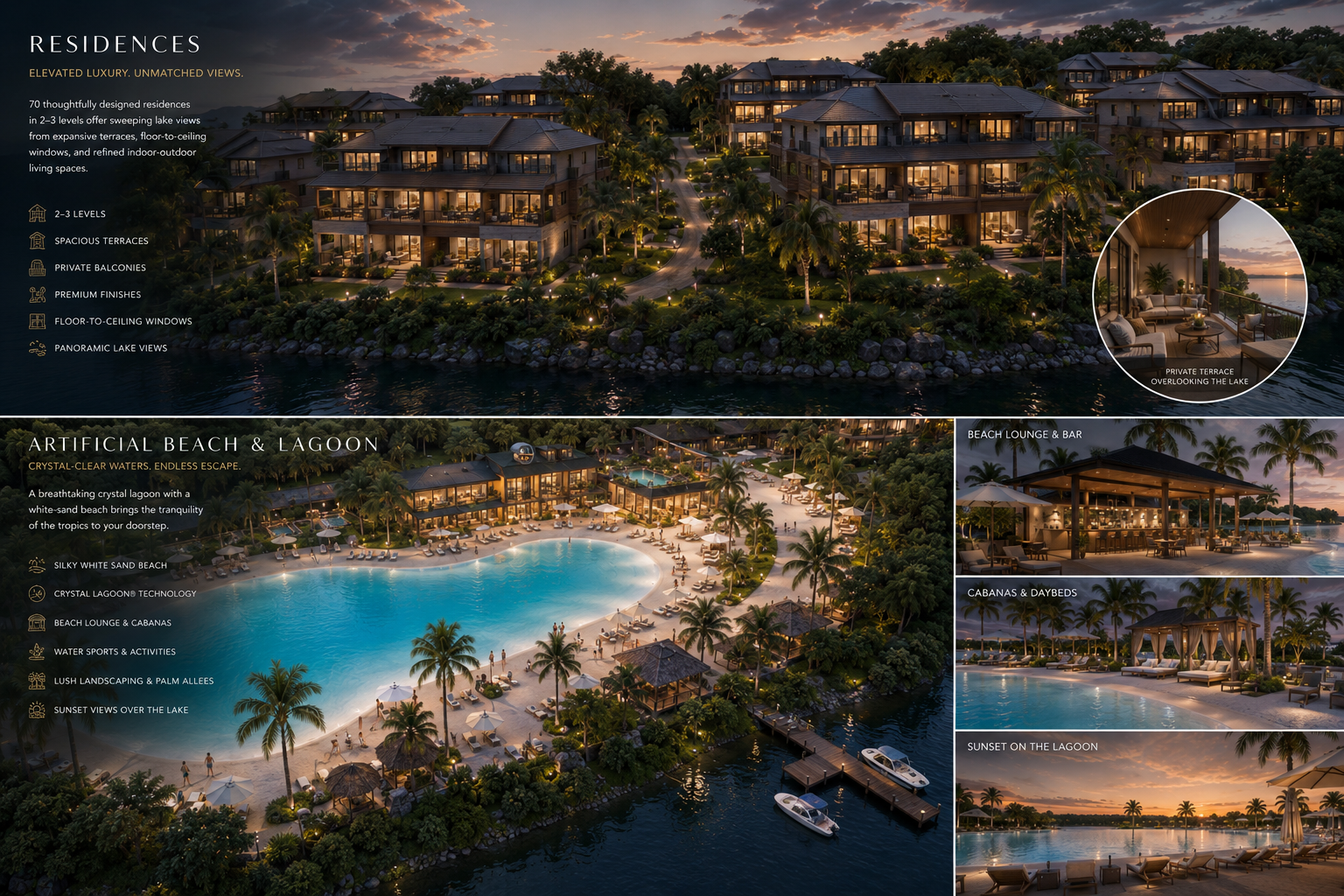
HOTELA Beach Club and Lakehouse at Toyako residence elevations and artificial beach & lagoon detail with sub-images of beach lounge, cabanas, and sunset view
Plate 2HOTELA Beach Club and Lakehouse at Toyako — residences + artificial beach & lagoonSplit view — residence elevations above (open terraces, panoramic lake views); artificial beach and lagoon below (crystal-clear waters, beach club & cabanas, water sports). Insets: beach lounge & bar, cabanas & daybeds, sunset on the lagoon.
HOTELA Beach Club and Lakehouse at Toyako residences overlooking the artificial beach at dusk, ambient lighting
Plate 3HOTELA Beach Club and Lakehouse at Toyako — residences over the beach at duskHero view — residences stepping down toward the beach, ambient lighting, low palms.
HOTELA Beach Club and Lakehouse at Toyako residences with HOTELA branded beach pavilion at right
Plate 4HOTELA Beach Club and Lakehouse at Toyako — beach pavilion & HOTELA markAlternate vantage — HOTELA-branded beach pavilion at right anchoring the social spine of the resort.
HOTELA Beach Club and Lakehouse at Toyako architectural language — open terraces, glass facades, integrated landscape along the lakefront walkway
Plate 5HOTELA Beach Club and Lakehouse at Toyako — architectural language detailOpen terraces, floor-to-ceiling glass, integrated landscape — architectural language for the open-air direction. Walkway frontage along the lake edge.
Renderings are early-stage concept — final architectural specifications produced at design stage. Both directions remain under active review; the cost stack in Section 04 (¥4,000,000,000 development) is sized to accommodate the more capital-intensive Direction B with overrun shared symmetrically through Phase 6 dilution.
Section 02 · The Deal in Brief

The entire deal, in twelve bullets.

Strip away the brand language, the design references, and the destination story. What follows is the deal as it would read in the term sheet — structural, dollar-and-yen, no adjectives.

01
Vehicle A new single-purpose Godo Kaisha (合同会社) is incorporated — the SPC GK. It is the only legal vehicle for the JV. Owned 50/50 by Jonathan and HOTELA at formation.
02
Your contribution You contribute the full ~30,000 sqm Lake Tōya parcel free and clear of all liens, mortgages, and operating overlays into the SPC GK at formation. The SPC GK acquires the land and the existing building from you for ¥4,000,000,000 (USD $25,316,456) minimum, plus a 50% profit-share on Phase 6 distributions. Payment is deferred and paid through the waterfall.
03
HOTELA's commitment HOTELA finances 100% of development and 100% of marketing. Roughly ¥7,000,000,000 (USD $44,303,797) in total HOTELA exposure — approximately ¥4,000,000,000 (USD $25,316,456) for build and ¥3,000,000,000 (USD $18,987,342) for sales and marketing. On formation, HOTELA loans the SPC GK ¥1,000,000,000 (USD $6,329,114) interest-free to fund design, planning, pre-launch marketing, and sales infrastructure.
04
No cash from you You contribute the land. You do not advance a single yen of cash into the SPC GK at any phase. No equity call, no construction draw, no marketing top-up.
05
Part 1 as previously proposed Your ¥500,000,000 (USD $3,164,557) loan to HOTELA — backed by a HOTELA corporate bond, together with a 17.5% limited-partner interest in HOTELA Niseko Towers — closes simultaneously with Part 2 on the same day. The bond is issued to you at disbursement and collateralizes the principal. The 17.5% LP interest is granted at the same moment and runs through the Niseko Towers sell-through. HOTELA deploys the ¥500,000,000 into HOTELA Niseko Towers sales and marketing. Your return comes in two tranches: (i) Tranche I — principal + interest within 18 months; (ii) Tranche II — pro-rata distribution on your 17.5% LP interest at HOTELA Niseko Towers full sell-through, paid uniformly with all other LP holders. Tranche II forecast (pre-tax): ¥840,000,000 – ¥945,000,000 (USD $5,316,456 – $5,981,013) at HOTELA Niseko Towers profit pool of ¥4.8B – ¥5.4B. Total Part 1 return: ¥1,340,000,000 – ¥1,445,000,000 (USD $8,481,013 – $9,145,570) ex interest. Bilateral with HOTELA Corporation, fully separate from the Lakehouse SPC GK waterfall — zero impact on your Lakehouse ¥10,000,000,000 – ¥12,500,000,000 (USD $63,291,139 – $79,113,924) economics. Part 1 and Part 2 execute in parallel from closing day; Lakehouse sales open in 6–12 months.
06
Waterfall All sales proceeds from the 70 units flow into the SPC GK and are distributed in six sequential phases. Each phase pays in full before the next begins. HOTELA receives no profit distribution until you have received your full ¥4,000,000,000 (USD $25,316,456). Full diagram in Section 02.
07
Your ¥4,000,000,000 floor ¥4,000,000,000 (USD $25,316,456) is paid to you before any HOTELA profit distribution. Specifically: ¥2,000,000,000 (USD $12,658,228) is treated as land-cost reimbursement (Phase 3), and a further ¥2,000,000,000 (USD $12,658,228) is paid as an advance on your 50/50 split (Phase 4). Only after both tranches are fully discharged does HOTELA receive its ¥2,000,000,000 (USD $12,658,228) catch-up (Phase 5).
08
Your upside above the floor From Phase 6 onward, every remaining yen of net proceeds is split 50/50 between you and HOTELA. Less any new capex or new marketing costs incurred after Phase 6 begins. No cap, no ceiling. Base case adds ~¥6,000,000,000 (USD $37,974,684) to your ¥4,000,000,000 floor; high case adds ~¥8,500,000,000 (USD $53,797,468).
09
Tax characterization The transaction is structured to qualify your receipts as capital-gains on land (Japan long-term: approximately 10–15% on land held longer than five years), not dividend / profit-distribution income. Driven by characterizing the SPC GK as purchasing the land for ¥4,000,000,000 (USD $25,316,456) + earn-out, with installment-sale recognition of capital gains over the payment schedule.
10
Operations carve-out The JV is for fractional sales only. Run-rate hotel operations (nightly stays, F&B, beach club, spa, concierge) sit entirely outside the JV under a separate operating agreement between HOTELA and the Nin'i Kumiai fractional-owner pool. You do not participate in operating revenue. You do not have operating liability.
11
Surrender on completion Once all six waterfall phases are fully discharged, you surrender your 50% SPC GK interest to HOTELA at de minimis consideration. Mechanism: pre-notarized agreement at formation, with consideration tied to waterfall-satisfaction event, so the surrender is substantively zero rather than a structured zero-out of valuable equity.
12
Tax basis disclaimer All figures in this brief are ex VAT, ex consumption tax, and ex other applicable taxes. USD equivalents are provided for reference only at ¥158 = USD $1.00. Tax-inclusive numbers and final tax structuring are set out in the definitive agreements.
Section 03 · Part 2 · Money Flow

Every yen of sales proceeds, six phases, in order.

All proceeds from fractional sales of the 70 units flow into the SPC GK bank account. Distributions follow the six phases below. Each phase pays in full before the next phase activates. No subordination. No discretion. No commingling with other obligations.

1 Cost Recovery
To HOTELA · sales commissions, marketing & advertising

HOTELA recovers every yen of sales & marketing spend

Broker commissions, campaign media, sales infrastructure, pre-launch marketing — all paid in full from incoming sale proceeds as units close. Cost recovery, not profit.

¥3,000,000,000 USD $18,987,342 approx · full reimbursement
2 Cost Recovery
To HOTELA · development cost incl. seed loan

HOTELA recovers construction, design & planning

Construction, architecture, planning, existing-structure repositioning, the amenity build, the engineered-beach component. Includes full repayment of the ¥1,000,000,000 (USD $6,329,114) interest-free seed loan HOTELA funded at JV formation. Still cost recovery, not profit.

¥4,000,000,000 USD $25,316,456 approx · full reimbursement
3 Land Cost
To Jonathan · baseline land payment

You receive ¥2,000,000,000 — treated as a cost line

The first ¥2,000,000,000 (USD $12,658,228) of your ¥4,000,000,000 minimum land-sale consideration. The SPC GK paying you for the land it acquired at formation. Accounting-wise, this is a cost line — reimbursement for the asset purchased. It is paid before HOTELA receives any profit.

¥2,000,000,000 USD $12,658,228 to Jonathan · land cost
4 Split Advance
To Jonathan · advance on the 50/50 split

You receive ¥2,000,000,000 more — first profit dollars to you

The second ¥2,000,000,000 (USD $12,658,228) of your ¥4,000,000,000 minimum. You take the first ¥2,000,000,000 of profit-pool distributions before HOTELA takes any. Completes your ¥4,000,000,000 (USD $25,316,456) contractual floor. HOTELA still has not received a yen of profit at this point.

¥2,000,000,000 USD $12,658,228 to Jonathan · split advance
5 Catch-Up
To HOTELA · profit catch-up

HOTELA's first profit yen — ¥2,000,000,000 catch-up

HOTELA receives the next ¥2,000,000,000 (USD $12,658,228) to equalize the cumulative profit split at ¥2,000,000,000 each side (matching your Phase-4 advance). Cumulative profit split is now exactly 50/50. This is HOTELA's first yen of profit in the entire transaction.

¥2,000,000,000 USD $12,658,228 to HOTELA · catch-up
6 50 / 50
To both · ongoing distribution

All remaining proceeds split 50/50

From this point forward, every remaining yen of net proceeds splits 50/50 between you and HOTELA. Less any new capex or new marketing costs incurred after Phase 6 begins. No cap. No ceiling. You participate equally in every yen of upside.

50 / 50 of remainder remaining proceeds
Cumulative to Jonathan
¥4,000,000,000 paid in Phases 3 + 4, then 50% of every yen above ¥13,000,000,000

Your full ¥4,000,000,000 (USD $25,316,456) is paid in Phases 3 + 4 before HOTELA receives its matching ¥2,000,000,000 catch-up in Phase 5. From Phase 6 onward (after cumulative sales clear ¥13,000,000,000 (USD $82,278,481)), you share every remaining yen 50/50.

Cumulative to HOTELA
¥7,000,000,000 cost recovery + ¥2,000,000,000 catch-up + 50% of every yen above ¥13,000,000,000

HOTELA recovers its full ¥7,000,000,000 (USD $44,303,797) of cost outlays in Phases 1 + 2, takes a ¥2,000,000,000 catch-up in Phase 5, and shares every remaining yen 50/50 from Phase 6 onward. HOTELA's first yen of profit arrives only after you have received your full ¥4,000,000,000.

Section 04 · Part 2 · The Numbers

Two cases. Same waterfall.

Base case anchored to approximately ¥357,000,000 (USD $2,259,494) average per unit on 70 units — ¥25,000,000,000 (USD $158,227,848) aggregate, ex tax. High case at approximately ¥428,000,000 (USD $2,708,861) average per unit — ¥30,000,000,000 (USD $189,873,418) aggregate, ex tax. The six-phase waterfall behaves identically in both — only the Phase 6 split moves.

Scenario A · Base Case

¥25,000,000,000 aggregate salesUSD $158,227,848

70 units · ~¥357,000,000 per unit (USD $2,259,494)
Phase 1 — Sales & marketing reimbursementto HOTELA
¥3,000,000,000 USD $18,987,342
Phase 2 — Development cost (incl. seed loan)to HOTELA
¥4,000,000,000 USD $25,316,456
Phase 3 — Baseline land paymentto Jonathan
¥2,000,000,000 USD $12,658,228
Phase 4 — 50/50 split advanceto Jonathan
¥2,000,000,000 USD $12,658,228
Phase 5 — Catch-upto HOTELA
¥2,000,000,000 USD $12,658,228
Remaining pool for Phase 6 (50/50)
¥12,000,000,000 USD $75,949,367
Phase 6 — Jonathan's 50%
¥6,000,000,000 USD $37,974,684
Phase 6 — HOTELA's 50%
¥6,000,000,000 USD $37,974,684
Jonathan total receiptcapital-gains characterization
¥10,000,000,000 USD $63,291,139
HOTELA total receipt¥7B cost recovery + ¥8B profit
¥15,000,000,000 USD $94,936,709
Scenario B · High Case

¥30,000,000,000 aggregate salesUSD $189,873,418

70 units · ~¥428,000,000 per unit (USD $2,708,861)
Phase 1 — Sales & marketing reimbursementto HOTELA
¥3,000,000,000 USD $18,987,342
Phase 2 — Development cost (incl. seed loan)to HOTELA
¥4,000,000,000 USD $25,316,456
Phase 3 — Baseline land paymentto Jonathan
¥2,000,000,000 USD $12,658,228
Phase 4 — 50/50 split advanceto Jonathan
¥2,000,000,000 USD $12,658,228
Phase 5 — Catch-upto HOTELA
¥2,000,000,000 USD $12,658,228
Remaining pool for Phase 6 (50/50)
¥17,000,000,000 USD $107,594,937
Phase 6 — Jonathan's 50%
¥8,500,000,000 USD $53,797,468
Phase 6 — HOTELA's 50%
¥8,500,000,000 USD $53,797,468
Jonathan total receiptcapital-gains characterization
¥12,500,000,000 USD $79,113,924
HOTELA total receipt¥7B cost recovery + ¥10.5B profit
¥17,500,000,000 USD $110,759,494

Stress test. At what revenue does your ¥4,000,000,000 break?

The table below walks the six-phase waterfall across seven aggregate-sales outcomes — from a deeply distressed ¥11,000,000,000 (USD $69,620,253), approximately ¥157,000,000 per unit, far below any HOTELA Niseko comparable — through the ¥35,000,000,000 (USD $221,518,987) upside case. The green-highlighted row is the floor pivot point.

Table 1 · Six-phase waterfall sensitivity across aggregate-sales scenarios (yen first, USD at ¥158 / $1.00, all ex tax)
Aggregate sales Jonathan receives HOTELA total HOTELA profit only Vs. ¥4,000,000,000 floor
¥11,000,000,000USD $69,620,253 ¥4,000,000,000USD $25,316,456 ¥7,000,000,000USD $44,303,797 ¥0USD $0 exactly at floor
¥15,000,000,000USD $94,936,709 ¥5,000,000,000USD $31,645,570 ¥10,000,000,000USD $63,291,139 ¥3,000,000,000USD $18,987,342 +¥1,000,000,000 above
¥20,000,000,000USD $126,582,278 ¥7,500,000,000USD $47,468,354 ¥12,500,000,000USD $79,113,924 ¥5,500,000,000USD $34,810,127 +¥3,500,000,000 above
¥25,000,000,000USD $158,227,848 ¥10,000,000,000USD $63,291,139 ¥15,000,000,000USD $94,936,709 ¥8,000,000,000USD $50,632,911 +¥6,000,000,000 above
¥27,500,000,000USD $174,050,633 ¥11,250,000,000USD $71,202,532 ¥16,250,000,000USD $102,848,101 ¥9,250,000,000USD $58,544,304 +¥7,250,000,000 above
¥30,000,000,000USD $189,873,418 ¥12,500,000,000USD $79,113,924 ¥17,500,000,000USD $110,759,494 ¥10,500,000,000USD $66,455,696 +¥8,500,000,000 above
¥35,000,000,000USD $221,518,987 ¥15,000,000,000USD $94,936,709 ¥20,000,000,000USD $126,582,278 ¥13,000,000,000USD $82,278,481 +¥11,000,000,000 above
Read: Your ¥4,000,000,000 (USD $25,316,456) floor is structurally protected at any aggregate-sales level at or above ¥11,000,000,000 (USD $69,620,253) — i.e., as long as the project clears more than approximately ¥157,000,000 per unit (well below the lowest HOTELA Niseko comparable). At ¥11,000,000,000, the waterfall is exhausted at Phase 4 and HOTELA receives zero profit — but you still receive your full ¥4,000,000,000. The point at which HOTELA reaches profit parity (cumulative 50/50) is ¥13,000,000,000 (USD $82,278,481). The structure is asymmetrically protective of you.
Section 05 · Part 2 · Floor Protection

How your ¥4,000,000,000 is structurally guaranteed.

Your ¥4,000,000,000 (USD $25,316,456) is not a promise. It is not a balance-sheet guarantee. It is not a subordination override. It is a structural feature of the waterfall itself — your ¥4,000,000,000 is paid in Phases 3 and 4, before HOTELA receives a single yen of profit in Phase 5. The math is in the contract, not in trust.

How the floor is built

¥4,000,000,000 to Jonathan = ¥2,000,000,000 Phase 3 (land cost)USD $12,658,228 + ¥2,000,000,000 Phase 4 (split advance)USD $12,658,228 = USD $25,316,456 total floor
Fully paid when sales ≥ ¥11,000,000,000 ¥7B HOTELA cost recovery + ¥4B youUSD $69,620,253 minimum sales
HOTELA reaches profit parity at ¥13,000,000,000 ¥7B cost + ¥4B you + ¥2B catch-up = 50/50USD $82,278,481 parity point

The structure is the protection.

Your ¥4,000,000,000 does not depend on HOTELA's balance sheet, a parent guarantee, a letter of credit, or a subordination override. It depends on six lines of contract language inside the SPC GK operating agreement. Those six lines say: HOTELA's profit distribution does not begin until ¥4,000,000,000 (USD $25,316,456) has flowed to Jonathan.

There is no scenario in which the project sells more than ¥11,000,000,000 (USD $69,620,253) aggregate and you receive less than ¥4,000,000,000. The cash sits in the SPC GK bank account governed by the waterfall — it physically cannot exit to HOTELA's profit account until your ¥4,000,000,000 is fully paid.

If the project performs at all — even a deeply distressed ~¥157,000,000 per unit average — you receive your full ¥4,000,000,000 (USD $25,316,456) and HOTELA receives zero profit. The waterfall is asymmetrically protective of you.

The structure is the floor. The thesis is the upside. HOTELA's conviction on absorption is built on validated comparables, an existing 13-language sales channel, and the brand-build velocity that Part 1 funds at HOTELA Niseko Towers. The constraint on Lakehouse sales is the marketing engine, not market demand.

"The chances of not being able to sell are limited only by cash and imagination. Once HOTELA's cash position becomes powerful from accelerated sales, marketing is truly all we need to focus on. Our competitors have already paved the way — now it is for us to drive through it." — Kyle Burns · HOTELA Cities KK

Five protections in your favor — one residual item to plan for

Protection · 01

Phase ordering in the operating agreement

The SPC GK operating agreement contains the six-phase waterfall as a binding distribution clause. Distributions to HOTELA profit accounts cannot be made until Phases 1–4 are fully discharged. Enforced at the bank-account level — the SPC GK distribution account is governed by the agreement, not by partner discretion.

Protection · 02

¥2,000,000,000 Phase 3 is cost, not profit

Your ¥2,000,000,000 (USD $12,658,228) baseline payment is the SPC GK paying you for the asset it acquired. It is a balance-sheet reduction — the SPC GK no longer owes you for the land — not a profit distribution. There is no "profit" yet to distribute or withhold when this payment is made.

Protection · 03

¥2,000,000,000 Phase 4 is the first profit yen — yours

Your Phase-4 advance is taken from the first profit-pool yen, ahead of HOTELA. First profit goes to Jonathan until you have been paid ¥2,000,000,000 (USD $12,658,228). Only then does HOTELA's Phase 5 catch-up begin. The structural override of any pro-rata standard distribution.

Protection · 04

50% GK ownership = governance security

During the waterfall period, you hold 50% of the SPC GK. Distributions cannot be amended, paused, or redirected without your consent. Your 50% interest is functionally collateral for the receivable, and naturally extinguishes (via the pre-notarized surrender agreement) once the receivable is fully satisfied.

Protection · 05 · Conviction

Constrained by cash and imagination — not market demand

Niseko comparables and HOTELA's 13-language direct-response sales channel have validated the price band; the constraint on Lakehouse sales is the marketing engine's strength, not market absorption. Part 1's ¥500,000,000 (USD $3,164,557) seeds the Niseko Towers brand engine that drives Lakehouse velocity. Accelerated early-sales cash funds expanded marketing — which compounds into more sales. Competitors have paved the trail; HOTELA executes on it.

Residual item · 01

Construction overrun

Overrun on the ¥4,000,000,000 development cost line dilutes the Phase 6 profit pool, not your ¥4,000,000,000 floor. Mitigation: overruns shared 50/50 through Phase-6 dilution — approximately ¥500,000,000 (USD $3,164,557) per ¥1,000,000,000 (USD $6,329,114) of overrun, post-split. Your ¥4,000,000,000 is unaffected. Final construction cost set at architecture and bid stage.

Section 06 · Tax Effectiveness · Both Parts

Capital gains, not profit distribution.

The structural choice that drives your tax-effectiveness is positioning the SPC GK as purchasing your land for ¥4,000,000,000 (USD $25,316,456) + earn-out, rather than receiving your land as an equity contribution and paying you a profit distribution out the other side. This shifts characterization from dividend income to capital gains on land — materially better treatment in Japan.

A
Characterization

Sale, not contribution

The SPC GK purchases the land and existing building from you for ¥4,000,000,000 (USD $25,316,456) minimum plus a 50% profit share on Phase 6 distributions. This is a sale-purchase transaction, not an in-kind capital contribution. Your receipts are sale proceeds — taxed as capital gains on land, not dividend / profit-distribution income.to confirm
B
Effective Rate

Approximately 10–15% long-term

On Japanese land held longer than five years, long-term capital gains is taxed at approximately 10–15% combined national + local, subject to current law. For comparison, profit-distribution income on a GK can attract ~20%+ withholding if you are non-resident, and full marginal-rate inclusion if resident. The capital-gains path is materially cheaper.to confirm
C
Installment Recognition

Gain recognized as paid

Because the ¥4,000,000,000 (USD $25,316,456) is paid through the waterfall over the project lifecycle rather than at formation, the transaction is structured as an installment sale (分割払い). Capital gains are recognized as payments are received, not lump-sum at formation. You do not face a ¥4,000,000,000 taxable event at formation when no cash has flowed. Both the ¥2,000,000,000 Phase 3 and the ¥2,000,000,000 Phase 4 receipts are recognized when paid.to confirm
D
Earn-Out

Contingent consideration

The 50% Phase 6 share is structured as contingent earn-out consideration on the same land sale — not a separate profit distribution. This preserves capital-gains characterization on the upside (¥6,000,000,000 base case (USD $37,974,684) / ¥8,500,000,000 high case (USD $53,797,468) portion), not just on the ¥4,000,000,000 floor. Your entire ¥10,000,000,000 – ¥12,500,000,000 (USD $63,291,139 – $79,113,924) stream qualifies for capital-gains treatment.to confirm
E
Acquisition Tax

Borne by SPC GK

Japan land-acquisition tax (不動産取得税) and registration tax (登録免許税) on the land transfer into the SPC GK are borne by the SPC GK, not by you. Mechanically these are computed on assessed value (固定資産税評価額) regardless of contract price, so the contract structure does not reduce them — but it also does not increase them. Cost flows through Phase 2 development-cost reimbursement.to confirm
F
GK Surrender

No tax on extinguishment

When Phase 6 is fully discharged and you surrender your 50% GK interest, the consideration is locked at formation-date value (zero / de minimis) per the pre-notarized surrender agreement. Because your receivable has been fully paid out by that point, the 50% interest has zero remaining economic claim — the surrender is substantively zero, not a structured zero-out of valuable equity. Survives Japan substance-over-form review by construction.to confirm
G
Cross-Border

Home-jurisdiction overlay

If you are non-Japan-resident at the time of receipt, Japan withholding on capital-gains on Japanese land is typically 10.21% (subject to current law and applicable tax treaties). Your home-jurisdiction treatment of the installment receivable, and tax-treaty coordination with Japan, is the cross-border overlay on your side. HOTELA handles the Japan-side structuring memo end-to-end.to confirm
H
Part 1 Instruments

Three instruments, three tax paths

Part 1 (see Section 07) consists of three separate instruments with distinct tax treatments, all bilateral with HOTELA Corporation and fully separate from the Lakehouse SPC GK economics. (i) Corporate bond: the par-¥500,000,000 (USD $3,164,557) HOTELA bond securing the principal — non-taxable when issued; extinguishes on Tranche I repayment. (ii) Tranche I (debt receivable): principal repayment within 18 months is non-taxable return of capital; interest portion is interest income. (iii) Tranche II (17.5% LP interest in HOTELA Niseko Towers): distributions are typically taxed in Japan as the LP-vehicle's flow-through character (Tokumei Kumiai → typically dividend-like withholding; Yūgen Sekinin Jigyō Kumiai → flow-through capital-gains-like on underlying); cross-border withholding for non-residents depends on vehicle and treaty. LP-vehicle form selection is the single highest-impact open item — it drives the tax characterization of Tranche II.open · TBD
Section 07 · Part 1 · Deep-Dive as previously proposed

Loan, corporate bond, and 17.5% limited-partner interest.

This is Part 1 of the deal. Three instruments delivered to you in exchange for your ¥500,000,000 (USD $3,164,557): a debt receivable, a HOTELA corporate bond securing it, and a 17.5% limited-partner interest in HOTELA Niseko Towers. Bilateral with HOTELA Corporation, fully ring-fenced from the Lakehouse SPC GK waterfall. Part 1 and Part 2 close simultaneously on the same day and run in parallel from there — Lakehouse sales open in 6–12 months from closing.

¥500,000,000 USD $3,164,557

Corporate-bond-secured loan + 17.5% LP interest in HOTELA Niseko Towers.

At Lakehouse JV formation, you transfer ¥500,000,000 (USD $3,164,557) to HOTELA Corporation. You receive in exchange: (i) a HOTELA Corporation corporate bond, par ¥500,000,000, issued in your name as security for the principal; (ii) a debt receivable for principal + interest, repayable within 18 months; and (iii) a 17.5% limited-partner interest in HOTELA Niseko Towers. HOTELA deploys the entire ¥500,000,000 into HOTELA Niseko Towers sales and marketing — the existing flagship, not Lakehouse. None of this is a contribution into the Lakehouse SPC GK. None of it is subject to the six-phase waterfall. Zero impact on your Lakehouse ¥10,000,000,000 – ¥12,500,000,000 (USD $63,291,139 – $79,113,924) economics.

Instrument · security
HOTELA corporate bond, par ¥500,000,000

Issued in your name at disbursement, collateralizing the principal. Bond instrument form, registration mechanics, and extinguishment-on-repayment language — HOTELA position TBD. Your downside on the principal is a contractual debt instrument secured by a HOTELA corporate bond — not unsecured exposure.

Tranche I · debt return
Principal + interest within 18 months

Repaid from HOTELA Niseko Towers project reimbursements (analog to Lakehouse Phases 1–2). Interest rate set in the bilateral instrument — likely arms-length market rate to avoid imputed-interest issues in Japan. HOTELA position TBD on the specific rate. Corporate bond extinguishes on principal repayment.

Tranche II · 17.5% LP interest
Limited-partner stake in HOTELA Niseko Towers

A 17.5% limited-partner interest in HOTELA Niseko Towers, delivering pro-rata profit distribution at the flagship's full sell-through, uniformly with all other LP holders. LP-vehicle form (Tokumei Kumiai / Yūgen Sekinin Jigyō Kumiai / other), governance rights, transfer restrictions, and Japan withholding treatment all set in the bilateral instrument.

Figure 2 · How Tranche II is paid

LP distribution flow at HOTELA Niseko Towers sell-through — uniform, pro-rata, no preferences.

All limited partners in HOTELA Niseko Towers are treated uniformly: every LP receives a pro-rata distribution at the same per-percentage terms. Jonathan's 17.5% receives 17.5% of every LP distribution — no preferential class, no super-rights, no preference stacks. Identical mechanics, scaled by percentage.

1
HOTELA Niseko Towers reaches full sell-through

All flagship units sold; the project enters its final distribution sequence. Gross proceeds calculated on a project-aggregate basis, ex tax.

project complete
2
Project costs and GP share resolved

HOTELA Corporation (as general partner / operator) recovers the project's cost stack (development, sales & marketing, including the deployment of Jonathan's ¥500,000,000 loan principal) and takes its GP economic share per the Niseko Towers vehicle terms. Note: Tranche I (¥500M principal + interest) is already repaid by month 18 — separately from this LP distribution.

cost & GP first
3
Remaining net profit becomes the LP distribution pool

What remains after Step 2 is the LP distribution pool — 100% allocated to limited-partner holders at their respective percentages.

100% to LPs
4
Pool distributed uniformly, pro-rata to every LP

The full LP pool flows out to all limited partners simultaneously and on identical per-percentage terms. An LP holder of X% receives exactly X% of the LP pool — no class preferences, no waterfall sub-tiers among LPs, no preferential treatment for any holder.

uniform pro-rata
5
Jonathan receives 17.5% of the LP pool

17.5% × LP distribution pool, paid directly to Jonathan. Identical mechanics to every other LP — only the percentage differs. The 17.5% is granted at Part 1 closing and held through final distribution; it does not extinguish with Tranche I principal repayment.

Tranche II · paid
Indicative LP cap-table position
Limited-partner holder LP percentage
Jonathan Hodgson 17.5%
All other LP holders (combined) 82.5%
Total LP distribution pool 100.0%
All LP holders share uniform terms: same vehicle, same distribution sequence, same per-percentage treatment. Jonathan's 17.5% is one slice of the standard LP pool — not a special class, not subordinated, not preferred. The remaining 82.5% sits with other HOTELA Niseko Towers LP investors under identical mechanics.
Figure 3 · Tranche II Forecast

What 17.5% LP translates to — estimated distribution at Niseko Towers sell-through.

Indicative pre-tax estimates for Jonathan's Tranche II receipt, sized against current underwriting of HOTELA Niseko Towers' net profit pool. Estimates only — final amount is determined by actual Niseko Towers sell-through performance.

Conservative · low end
HOTELA Niseko Towers pretax profit pool
¥4,800,000,000
USD $30,379,747
Jonathan's 17.5%Tranche II
¥840,000,000USD $5,316,456
Mid case
HOTELA Niseko Towers pretax profit pool
¥5,400,000,000
USD $34,177,215
Jonathan's 17.5%Tranche II
¥945,000,000USD $5,981,013
Total Part 1 return to Jonathan — Tranche I principal + Tranche II
Component Conservative Mid case
Tranche I — principal returned by month 18 ¥500,000,000USD $3,164,557 ¥500,000,000USD $3,164,557
Tranche I — interest portion (rate TBD) + interest TBD + interest TBD
Tranche II — 17.5% LP distribution at sell-through ¥840,000,000USD $5,316,456 ¥945,000,000USD $5,981,013
Total Part 1 return (excl. interest) ¥1,340,000,000USD $8,481,013 ¥1,445,000,000USD $9,145,570
Forecast caveat: Pre-tax, ex-VAT, ex-consumption-tax. Tranche I principal is non-taxable return of capital; interest is interest income; Tranche II is taxed under the LP-vehicle's flow-through character (see Section 06 Item H). Estimates based on HOTELA Niseko Towers current underwriting; final amount depends on actual sell-through performance, LP-vehicle distribution mechanics, and any new capex or marketing costs incurred during the sell-through window. Indicative only — not a guaranteed minimum.

Why Part 1 is structural — and why both parts run in parallel. Your ¥500,000,000 (USD $3,164,557) funds the brand engine. HOTELA Niseko Towers sales velocity is what lifts Lakehouse pricing at launch. Three layers of return: (i) interest on principal within 18 months, secured by the corporate bond; (ii) pro-rata distribution on your 17.5% LP interest at HOTELA Niseko Towers full sell-through, paid uniformly with all other LP holders; (iii) indirect compounding back to your Lakehouse JV economics through HOTELA brand-build strength. The two parts close on the same day and execute in parallel from the moment of closing — Part 1's ¥500M deployment funds the Niseko Towers campaign while, simultaneously, Part 2's SPC GK begins masterplanning, surveys, architectural drawings, land-development permits, and Lakehouse marketing. Lakehouse sales open in 6–12 months from closing; Tranche I principal returns to you by month 18; Tranche II flows on the 17.5% LP interest at Niseko Towers sell-through.

Section 08 · Open Items · Both Parts

Twenty-nine questions for HOTELA.

The list below is what HOTELA needs to align on and discuss with you before this draft becomes a binding term sheet. Sharing those questions with you upfront — alongside this brief — is faster than discovering them mid-draft. Grouped by category. Roughly ordered by what blocks the term sheet first.

Waterfall · 01

Sales-pacing contingency planning

Contingency planning only — not a probability statement. Niseko comparables and HOTELA's 13-language sales channel underwrite the band; the constraint on Lakehouse sales is the marketing engine, not market demand. HOTELA position TBD on the formal contingency mechanic (extended marketing window, additional sales channels, pacing adjustments) if sales velocity in any quarter falls behind the underwriting curve.

Waterfall · 02

New-capex policy after Phase 6 begins

If new amenity build, refurbishment, or upgrade is incurred after Phase 6 distributions begin, how is the cost shared? Standard treatment: 50/50 pre-split, 50/50 remaining proceeds. Threshold above which approval is bilateral?

Waterfall · 03

New-marketing policy after Phase 6 begins

Same question for ongoing marketing for remaining unsold units after Phase 6 starts. HOTELA's view: these flow through Phase 1 reimbursement as incurred (off the top), not off the Phase-6 split. HOTELA to confirm structure.

Waterfall · 04

Unit-by-unit vs project-aggregate

Confirming: the waterfall is project-aggregate, not unit-by-unit. Each sale's proceeds enter the SPC GK and are distributed per cumulative waterfall position. A specific unit's sale does not trigger a specific phase payment.

Tax · 01

Capital-gains characterization, full receipt stream

HOTELA to confirm that both the ¥4,000,000,000 (USD $25,316,456) fixed component and the 50% earn-out qualify as capital-gains on land (not dividend / profit-distribution). The highest-value tax item — drives 10–15% rate vs 20%+ alternative.

Tax · 02

Installment-sale recognition timing

Confirm Japan tax authorities accept installment-recognition of capital gains over the waterfall payment schedule (each payment as received), rather than full recognition at formation when no cash has flowed.

Tax · 03

Your tax residency at receipt date

If non-Japan-resident at receipt, Japan withholding on capital-gains on Japanese land is typically 10.21%. Your home-jurisdiction overlay (and any applicable tax-treaty coordination) is a cross-border item — HOTELA handles the Japan side; the home-jurisdiction side is your call when you're ready.

Tax · 04

Acquisition + registration tax cost-sharing

Confirm both taxes are borne by the SPC GK at formation, flowing through Phase 2 development-cost reimbursement (not netted off your Phase 3 payment). Computed on assessed value, not contract price.

Structure · 01

GK surrender mechanism — form selection

Three forms available: (a) notarized pre-sale agreement at formation; (b) drag-along / redemption clause inside the JV operating agreement triggered by waterfall completion; (c) contingent transfer instrument with consideration formula. HOTELA position TBD.

Structure · 02

Hotel operating agreement scope

The operating agreement between HOTELA and the Nin'i Kumiai fractional-owner pool — for nightly stays, F&B, beach club, etc. — sits outside the JV. You do not participate in operating revenue. HOTELA to confirm no clause flows back into SPC GK economics.

Structure · 03

Free-and-clear contribution preconditions

Title, survey, zoning, environmental status, shoreline rights, and confirmation of any liens / mortgages / operating overlays on the 30,000 sqm parcel. Required before contribution into the SPC GK.

Structure · 04

Exclusivity window and break fee

From NDA to term sheet — what exclusivity period commits you not to entertain parallel development proposals? Standard practice 90–180 days. Break-fee terms if either side walks during diligence.

¥500M Loan · 01

Corporate bond — issuance form & mechanics

HOTELA Corporation issues a corporate bond, par ¥500,000,000 (USD $3,164,557), to Jonathan at disbursement as security for the principal. Form (registered note vs. bearer bond), recordation, and extinguishment-on-repayment language — HOTELA position TBD.

¥500M Loan · 02

Interest rate on principal

18-month repayment with interest implies a defined rate. Arms-length market rate to avoid imputed-interest issues. HOTELA position TBD — specific rate based on Japan AFR-equivalent and market comparable.

¥500M Loan · 03

17.5% LP interest — anti-dilution & transfer restrictions

17.5% is locked in this brief. HOTELA position TBD on the anti-dilution mechanics (does the 17.5% survive a future Niseko Towers capital raise, or dilute pro-rata?), transfer restrictions on the LP interest, and any change-of-control triggers. Pre-emption rights on subsequent LP issuance to be specified.

¥500M Loan · 04

LP vehicle form — Japanese-law selection

Which LP-vehicle form does HOTELA Niseko Towers use — Tokumei Kumiai (匿名組合), Yūgen Sekinin Jigyō Kumiai (有限責任事業組合), Godo Kaisha equity tranche, or other? Direct impact on Tranche II tax characterization and Japan withholding for non-residents. Highest-impact Part 1 tax item.

¥500M Loan · 05

Documentation form across the three instruments

One umbrella instrument referencing bond + debt + LP, or three parallel instruments (corporate-bond indenture + loan note + LP-vehicle subscription)? Japanese law tends to prefer explicit per-instrument form for tax-characterization clarity. HOTELA position TBD.

¥500M Loan · 06

LP distribution timing and cadence

Are LP distributions paid only at final sell-through, or pro-rata as Niseko Towers units close? Does the LP interest survive past principal repayment of Tranche I, or extinguish together? HOTELA position TBD — distribution mechanics to be specified in the LP-vehicle docs.

¥500M Loan · 07

LP interest — source entity and governance rights

Does the LP interest sit in HOTELA Corporation directly, or in a Niseko Towers SPV / subsidiary? Limited-partner consent rights, information rights, and any voting on Niseko Towers major decisions — HOTELA position TBD.

¥500M Loan · 08

Ring-fencing between Part 1 and Part 2

Confirming Part 1 (loan + corporate bond + 17.5% LP) and Part 2 (Lakehouse SPC GK waterfall) are fully ring-fenced instruments — the performance, distribution timing, and economics of one do not affect the other. HOTELA position: ring-fenced; HOTELA to lock the precise ring-fence language in the bilateral instrument.

Operational · 01

Pre-construction operating cutoff date

You retain 100% of Lakehouse at Toyako rental revenue up to the date HOTELA's ¥1,000,000,000 (USD $6,329,114) seed loan is funded into the SPC GK bank account. What counts as "funded" — wire-initiation, settlement, or confirmation? HOTELA position TBD — specific language to be locked.

Operational · 02

Construction-period non-compete

From funding date through Phase 6 completion, you commit not to entertain parallel development, sale, or operating arrangements on the 30,000 sqm. HOTELA position TBD — specific scope and duration to be locked.

Operational · 03

Confidentiality and partner-name use

HOTELA's preference: confidentiality through term sheet; joint announcement coordination; no public reference to specific terms or numbers in either direction until binding agreements are signed.

Operational · 04

Information rights during construction

How frequently does HOTELA report financial and operational status to you during the construction-and-sales window? Monthly construction draws, quarterly sales reporting, board-level governance through your 50% GK seat? HOTELA position TBD — reporting cadence to be locked.

Operational · 05

Existing structure repositioning approval

The existing Lakehouse building becomes the social spine of the resort (clubhouse, F&B, members lounge). Approval gates on the architectural treatment of the existing structure — does HOTELA execute unilaterally, or do you have approval rights on the repositioning brief?

Operational · 06

Engineered-beach permitting risk allocation

The artificial beach is delivered through an established global lagoon-engineering specialist. Permitting risk is well within precedent — but if a regulatory denial occurs, who absorbs the design cost incurred? Standard treatment: cost flows through Phase 2 reimbursement. HOTELA to confirm.

Operational · 07

Nin'i Kumiai sales — Takken Gyō Hō confirmation

HOTELA to confirm that Nin'i Kumiai partnership subscriptions are not regulated under Takken Gyō Hō (宅地建物取引業法) and therefore do not require a real-estate licence for the SPC GK or its sales agents. HOTELA Niseko operates this model today — HOTELA validates the continued precedent in Hokkaido for the Toyako site.

Operational · 08

LDP filing timeline & sales-opening trigger

Sales open on LDP (Land Development Permit) approval, not construction completion. HOTELA development team to lock the realistic LDP filing-and-approval window for the Toyako site (target 3–6 months from closing), agency-by-agency, with contingency if shoreline / environmental review extends timeline.

Marketing · 01

"First-of-its-kind" enclosed-beach claim — precedent search

Marketing/legal precedent search before any "world's first" or "first-of-its-kind" claim is published. Closest precedents: Tropical Islands (Germany — enclosed beach with hotel rooms, no branded residences inside); Seagaia Ocean Dome (Miyazaki, closed 2007 — water park). Branded-residence ownership inside an enclosed all-year beach appears genuinely novel — HOTELA marketing & legal to confirm the precise language that survives advertising-standards review.
Next Step · The Follow-up Call

Read it once. Push back where it deserves it.

Then let's get on a call — just the two of us. Most of the open items in Section 08 are answerable in a single working session between you and me. From there we move directly to a binding term sheet covering both Part 1 and Part 2.